Tuesday, January 5, 2016

Friday, December 25, 2015
Snow Storm Preparedness
 Prior to any big storm, anxiety can set in. "Will I miss my work obligations tomorrow?" "What will the roads be like?" "How much snow are we getting?" Well here's the deal: the roads will be terrible, because the first storm of the season means everyone forgets how to drive in the snow! There will be accidents all over the place! While you drive by all the popup accidents and misfortunes on the road, consider that you also will have misremembered precisely how to handle in snow.
 Assuming you make it home, how do you prepare for the storm at the house? This is how a typical New Englander does it.
1) Buy a large amount of salt and sand and mix it in a bucket by the back door. CHECK
2) Then, strategically place one shovel each at the front door and the back door. CHECK
3) Get the bins with the winter gloves/hats and boots out from the closet/attic. CHECK
4) Turn a little heat on in the basement/garage so the pipes don't freeze. CHECK
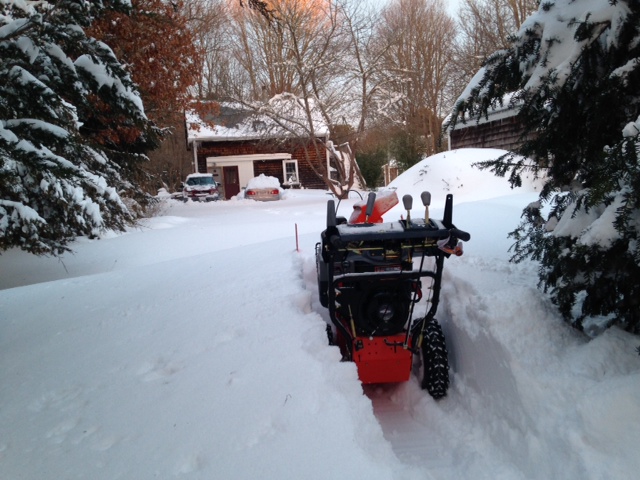 5) Get out the snowblower, refill it with fresh gas and start it, just to be sure it runs. CHECK
5) Call your parent's snowplow guy to double check they are on his list. CHECK
Finally, once everything is settled, turn on Channel 3 to get the weather, and call a friend to debate the different forecasts.
We New Englanders are a proud bunch when it comes to winter preparedness. Like behavior precoded into an animal's DNA, our wintertime rituals are ingrained from the generations back to our Puritan past. We have all the strategies to prevail over what the winter throws at us. It just takes that first storm to remember...
written by Andrew Bachman, Owner of Trout Brook Landscaping LLC in West Hartford, CT
(860) 888 8472 http://www.troutbrooklandscapingct.com/snow-removal-snowblowing
Wednesday, December 23, 2015
Keep Your Christmas Tree Well Watered
Watch what happens when fire touches a dry tree & a well-watered treehttp://youtu.be/RNjO3wZDVlA Water that holiday tree!
For more information visit:
https://www.usfa.fema.gov/prevention/outreach/holiday.html
https://www.usfa.fema.gov/prevention/outreach/holiday.html
Saturday, August 1, 2015
Tree Sculpture
Tree shaping or Arbor sculpture, is the practice of shaping, bending, and grafting the same tree or two of the same species of tree together to form living structures. Living artistic designs, and functional art like chairs and tables and mirrors have been created using this technique.
Reknowned artist Axel Erlandson (1884-1964) created more than 70 tree sculptures in his lifetime, at his Tree Circus farm in Scotts Valley, California. When asked how he created them, he replied mystically “ I talk to them”. Beyond tree-man communication, the physical work is complex, involving grafting compatible trees together. In nature, root occurs all the time in the forest and the phenomenon is called "inosculation." In grafting, the two cambial layers of the tree will connect and grow as one. The cambium is the layer of growth cells that create the xylem and phloem (vascular system) and cause the diameter increase of the roots or trunk.
Root grafting helps native mature trees to share immune signals and hormones. Through a shared vascular system, trees of the same species support each other with nutrients and anchorage against strong winds. Powerful mature stands of trees in this way express a grandparent and grandchild relationship between the apex trees and their fledgling descendants. In the forest, maples, pines, sycamore and elms participate in root grafting. Native branch grafting, while less common, is supported by the Sycamore, Beech, and Hornbeam and others. Tree branches or trunks can also be grafted artifically by physically removing the outer bark and securing together the two cambium layers of the wood. This allows for infinite possibilities of shape and growth, which dedicated and patient artists like Axel Erlandson grow into art!
The earliest known tree sculpting examples are found in northern India. For centuries, the Khasi people used the living roots of the Banyan Ficus to create suspension bridges to allow passage over deep ravines. These suspension bridges have been known to hold over fifty people, some of them 100 feet long and 200 years old. This practice spread to the Middle East where Ancient Persians would shape and graft trees to form garden sheds and living arbors. In a very practical usage, Mideival farmers created braided or pleated hedgerows, which formed impenetrable living walls to keep cows in and predators out. In the 15th -19th centuries Rennaisance and then Victorian gardeners would create elaborate covered walkways and gate structures out of hornbeam tree. The bending, shaping, creasing and grafting of trees requires years of patience, careful planning, skill and artistic imagination. Modern tree scultping has evolved into sustainable creations such as living chairs, benches, tables, mirror frames and even full dwellings. People nowadays want more than ever to be able to connect to their art and add to the artists concept over time. Tree Scultings as a design practice emobdies the ideal of "art as a living thing" and will most definitely become more popular over time.
Written by Richard Caldwell and Andrew Bachman
Arborists employed by Trout Brook Landscaping and Tree Service of West Hartford, CT
Saturday, July 11, 2015
JULY Tree of the Month: American Hornbeam - Carpinus Caroliniana

Carpinus
caroliniana Walter,
or the American Hornbeam, is in my opinion one of the most underrated
native tree species. This is an absolutely beautiful tree with
delicate looking light green foliage and a strong muscular grey bark
that is similar to the Beech family, but in fact is in the Birch
Family. Commonly known as Ironwood, as well as Blue Beech, Water
Beech, and Musclewood. The name Ironwood is also, and more aptly used
for, the American Hop hornbeam or Ostrya
virginiana (also in
the Birch Family),
as well as the
Persian Ironwood or Parrotia
persica, which is
more related to Witch Hazel (Hamamelidaceae) than the Hornbeam. Or
many species of tree around the world with an extremely dense
hardwood, including one of my personal favorites, Lignum
vitae (a South
American hardwood also known as Ironwood).
This is exactly why
Carl Linnaeus invented the scientific Latin binomial system, to avoid
the confusion associated with the common names of each tree species.
The name Walter is the discoverer of the tree, Thomas Walter, an
early American Botanist who is most famous for his book ‘Flora
Caroliniana’ (1788).
A
slow growing tree that can grow to thirty feet or more in the
northeast and maybe upwards of
 seventy feet or more with enough time,
nobody knows. Apparently, in southern Mexico and Central America this
tree grows much larger, due to a more favorable tropical wet climate.
But alas we live in the Northeast, and as the trees do, we have to
live with the same harsh winter season. The thin simple leaf is a
light to medium green color with an alternate growth pattern. The
leaves have a serrated, ovate-oblong, acuminate, rounded or even
heart shaped form that is very Birch like. The bark is a recognizable
smooth grey with a sinewy and muscular growth form that reminds some
of a Beech. Even with an extremely tough and hard wood, the younger
bark itself is somewhat susceptible to mechanical damage, so climbers
tread lightly. Propagation from seed collected prior to fall chill
and transplanting with a shallow but wide root ball are recommended
seventy feet or more with enough time,
nobody knows. Apparently, in southern Mexico and Central America this
tree grows much larger, due to a more favorable tropical wet climate.
But alas we live in the Northeast, and as the trees do, we have to
live with the same harsh winter season. The thin simple leaf is a
light to medium green color with an alternate growth pattern. The
leaves have a serrated, ovate-oblong, acuminate, rounded or even
heart shaped form that is very Birch like. The bark is a recognizable
smooth grey with a sinewy and muscular growth form that reminds some
of a Beech. Even with an extremely tough and hard wood, the younger
bark itself is somewhat susceptible to mechanical damage, so climbers
tread lightly. Propagation from seed collected prior to fall chill
and transplanting with a shallow but wide root ball are recommended


Written by: Richard
Caldwell, ISA arborist, 20 year tree industry veteran climber
Sunday, June 14, 2015
June Father's Day Bonus - "Corkscrew Willow" by Richard Caldwell
 Salix matsudana
‘Tortuosa’,
commonly known as the Corkscrew Willow, Contorted Willow, Curly
Willow, Pekin Willow, Hankow Willow and the Dragon’s Claw Willow.
In the family Salicaceae, which includes all deciduous Willows,
Poplars and even the Quaking Aspen, the Corkscrew willow is one of
the more attractive and ornamental varieties in the family. Named
after the Japanese botanist Sadahisa Matsudo, who wrote about the
trees in China more than a hundred years ago. I have a particular
fondness for this tree because of the curly and contorted branch
growth that resemble Harry Lauder’s Walking Stick (Corylus
avellana ‘Contorta’),
which is a curly
Hazelnut variety.
Some classify this tree as Salix
contorta; I believe
it is the same tree as the S.
matsudana ‘Tortuosa’. The
branches, with their twisting habit are prized for craft projects and
I have made beautiful golden, light and strong walking sticks from
the Dragon’s Claw Willow.
Salix matsudana
‘Tortuosa’,
commonly known as the Corkscrew Willow, Contorted Willow, Curly
Willow, Pekin Willow, Hankow Willow and the Dragon’s Claw Willow.
In the family Salicaceae, which includes all deciduous Willows,
Poplars and even the Quaking Aspen, the Corkscrew willow is one of
the more attractive and ornamental varieties in the family. Named
after the Japanese botanist Sadahisa Matsudo, who wrote about the
trees in China more than a hundred years ago. I have a particular
fondness for this tree because of the curly and contorted branch
growth that resemble Harry Lauder’s Walking Stick (Corylus
avellana ‘Contorta’),
which is a curly
Hazelnut variety.
Some classify this tree as Salix
contorta; I believe
it is the same tree as the S.
matsudana ‘Tortuosa’. The
branches, with their twisting habit are prized for craft projects and
I have made beautiful golden, light and strong walking sticks from
the Dragon’s Claw Willow.

The leaves are a light
green with a gray green underside, and then turn a slightly darker
green in summer and yellow fall foliage. It is a linear-lanceolate
simple leaf which is alternate along the branch and curl just as much
as the branch growth. The branches obviously twist and contort with
an upright and outward growth. Very light green to yellow bark color
on younger branches, the larger branch and trunk bark is a common
Willow look, not overly attractive or noteworthy. Catkins are the
flower of choice for the Willows, appearing in spring the tree form
itself at maturity is usually an oval to rounded crown that can reach
upwards of forty feet or more, eventually.
Salix matsudana
‘Tortuosa’ is
hardy to the Connecticut region (6) and can grow in zones 4 to 8. It
prefers cool moist soil environment in temperate climates, however is
more drought tolerant than most Willows. Easily propagated from
cuttings, as are all in the Salicaceae family. This is due to the
natural abundance of rooting hormone in this species, which are used
commercially for rooting hormone products. Salicylic acid is another
commercial product derived from the Willow family; this is otherwise
known as aspirin. So the next time you have a headache and you see a
Willow tree, chew on a tender leaf stem.
Article by Richard Caldwell, ISA arborist and horticulturalist at
Trout Brook Landscaping
For contact information for pruning and planting www.troutbrooklandscapingct.com
Article by Richard Caldwell, ISA arborist and horticulturalist at
Trout Brook Landscaping
For contact information for pruning and planting www.troutbrooklandscapingct.com
Saturday, June 6, 2015
Tree of the month JUNE: Paperbark Maple!
Acer
griseum, or
commonly known as Paperbark Maple is a deciduous specimen tree of
great beauty and aesthetic value. Most notable for its exfoliating red bark, it also has exceptional fall foliage color, which varies slightly tree to tree
 . Its upright oval to round growth habit is consistent with
most Maple trees, however this species of Maple is slower growing and
shorter than most of the genus Acer.
Only reaching approximately 20 to 30’ and may grow up to 50’
after many years. The oldest specimen in the United States is said to
be over 100 years old, far older Paperbark Maples can be found in
other parts of the world. It’s native to central China, grown in
Europe and was introduced to the United States in 1901. The Paperbark
Maple hardiness zone extends from zones 5 to 7 for good growth, but
will survive in zones 4 and 8. Connecticut fall into roughly zone 6,
moreover this is the perfect latitude for the Paperbark.
. Its upright oval to round growth habit is consistent with
most Maple trees, however this species of Maple is slower growing and
shorter than most of the genus Acer.
Only reaching approximately 20 to 30’ and may grow up to 50’
after many years. The oldest specimen in the United States is said to
be over 100 years old, far older Paperbark Maples can be found in
other parts of the world. It’s native to central China, grown in
Europe and was introduced to the United States in 1901. The Paperbark
Maple hardiness zone extends from zones 5 to 7 for good growth, but
will survive in zones 4 and 8. Connecticut fall into roughly zone 6,
moreover this is the perfect latitude for the Paperbark.

The attractive bark is
reddish bronze to cinnamon brown, with the older bark exfoliating
paper thin sheets exposing smooth satin textured red/ bronze. It’s
as though a Maple tree was crossed with Himalayan Paper Birch and
Japanese Cherry trees. The leaves are maple like, but are known as
trifoliate, which means the leaf is separated into three leaflets as
can be in the Box Elder (Acer
negundo). The leaf
color Usually is a dark bluish green with a silvery gray underside
(this is where the Latin name for gray comes in, griseus), this turns
to bronze, russet red, vibrant red, and even to red orange with pink
tones depending on the individual tree and climate. The Paperbark
Maple does not produce showy flowers, and the maple samara
(helicopter) seed pod is usually devoid of seed. This makes
propagation from seed problematic at best. Cuttings and cloning are
used as well, but with equal difficulty.

The
Paperbark Maple is not susceptible to any serious pest or disease
problems, however certain cultural practices should be observed. It
should be planted in a moist slightly acidic and well-drained soil,
and watered regularly due to its lack of drought tolerance. Full sun
to part shade, planted in groves, forest borders or singularly in a
backyard are all good for this spectacular specimen tree.
Written by Rick Caldwell,
ISA arborist, Horticultural expert and 19 years experienced tree climber and crew leader
Subscribe to:
Posts (Atom)